
-
Before 2017
Early Life
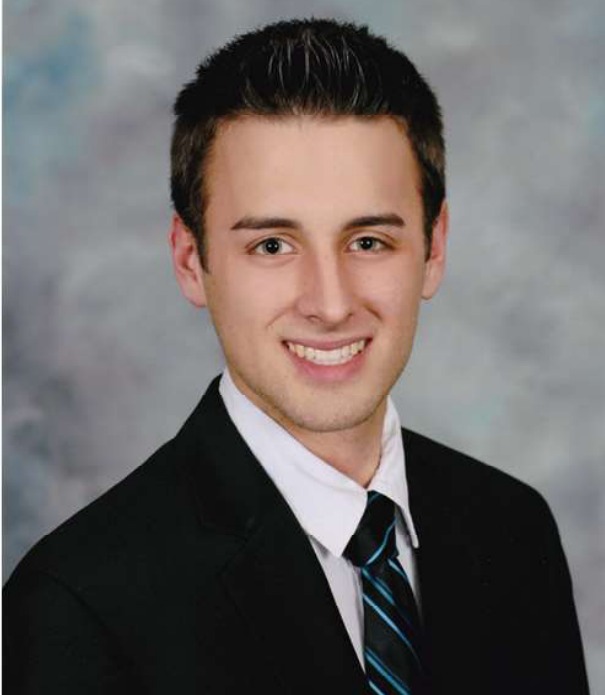
S1 — Photo of myself, before the onset of my illness. I never had any health issues growing up, and I rarely got sick (S1). I played sports throughout my life, including cross country, tennis and frisbee. I was in the Boy Scouts from a young age, going on camping trips year-round and volunteering in my community. I once camped in −4°F weather (−17°F with wind chill), and I eventually reached the rank of Eagle Scout. My Eagle project was renovating an emergency access pathway at a local park so that medical vehicles could reach hikers.
My greatest academic strength was always mathematics. I had perfect scores on the math sections of the SAT and AP exams, and even on the GRE when applying to graduate school, without studying at all. I led my entire high school in mathematics performance. I could ace math tests without studying, and sometimes I would work out mathematical and scientific principles during a test as I was taking it. At my teacher's request, I stayed after school to help my classmates study.
As an undergraduate, I took a special invite-only mathematics class, on par with what MIT teaches. I double-majored in Molecular and Cell Biology and in Structural Biology and Biophysics, joined my university's biology-based academic fraternity, and was nominated to be its academic chair. After graduating, I became a Research Assistant at a prestigious university, synthesizing custom oligonucleotides in a production lab.
-
2017
My Life Suddenly Over Without Warning
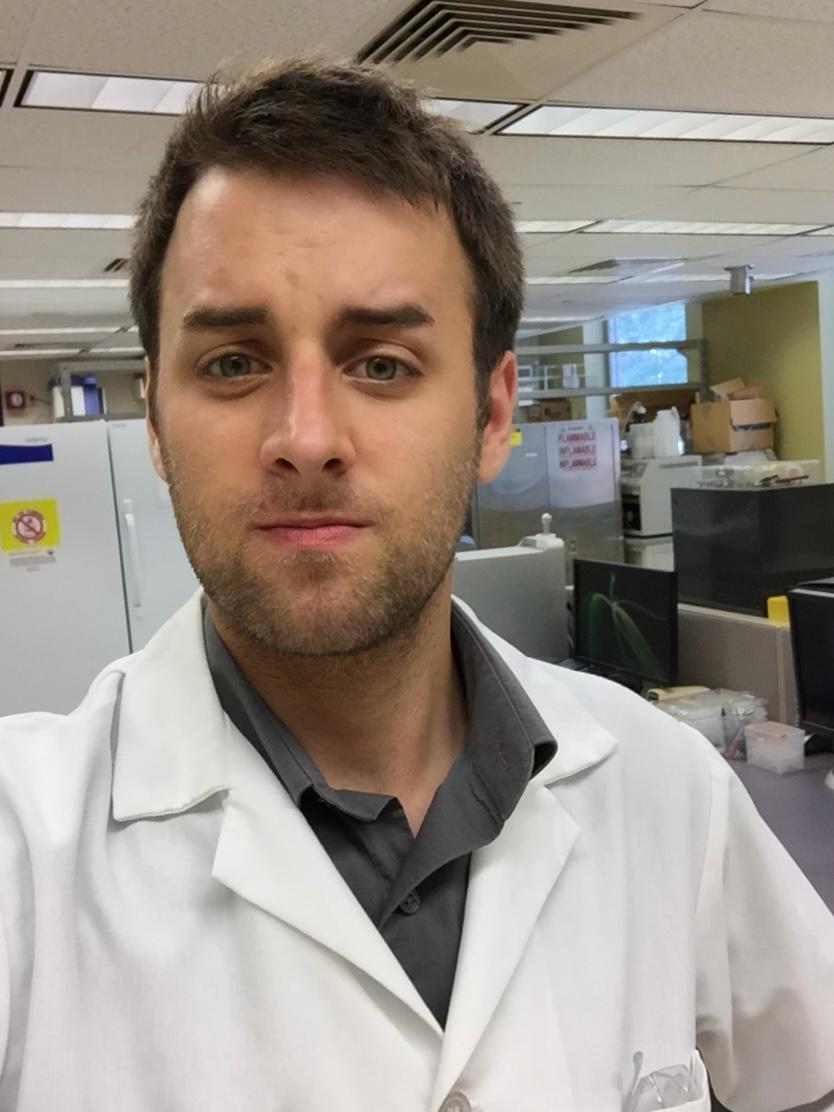
S2 — Working in a lab where I handled hazardous chemicals. In 2017, I was working as a research assistant in an oligonucleotide production lab, where I had worked for four years. Just a week before I was due to leave the job to start a PhD in Biology, I handled a particularly hazardous chemical called hydrazine (S2). Hydrazine is best known as a rocket propellant, used by the military and space agencies to fuel missiles, spacecraft and satellites, and it has been described as so toxic that it makes gasoline look like tap water. I didn't know at the time what this chemical could do to me. Soon after, I woke up with a sharp pain in my side that hurt when I breathed. I went on a routine hike that should have been easy, yet it left me unusually tired.
The following day at work, I completely fell apart. I went pale, started pouring sweat, grew dizzy and short of breath, and felt like I was about to pass out. I had no idea what was happening to me. I walked across the street to the emergency room and collapsed on the receptionist's desk. They barely did any testing before sending me home. I only had a couple of days left on the job, so I decided to push through and finish my work. Then I packed my car with all of my belongings and drove by myself out of state to begin the PhD program I had worked so hard throughout my adult life to get into.
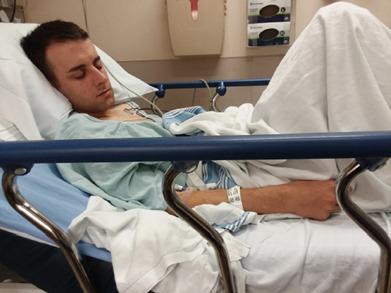
S3 — Hospitalized as an inpatient shortly after the hydrazine exposure. Although my symptoms waxed and waned, I kept getting worse. I spent time as an inpatient at a hospital and had all kinds of tests run (S3), and my attending physician told me, "I have no doubt you will be perfectly fine in two weeks' time." I really didn't have any choice but to take his word and keep pushing forward in my PhD program. There I worked 80 to 100 hours a week, determined not to give up the career I loved. On top of this, I was obsessively researching my own medical condition, because I had no one else to help me, while also working on acquiring incubator space and venture capital funding to start my own biotech company, which was about to make me the first student in the school's history to do so. The exhaustion was unreal. I tried using caffeine and stimulants to keep myself awake, which only made me crash harder and sent me to the emergency room every couple of days. I was terrified of falling asleep, because I felt that if I went to sleep, my brain wouldn't wake up. So instead of sleeping, I propped my head up with pillows at my desk, next to my little lamp, so that I could keep reading research papers all night. I don't know how many I read, but it was in the thousands. I pushed, and pushed, and pushed. Looking back, I still have no earthly idea how I was able to do that. But strong will and determination will only get you so far. Eventually your body gives out, even if your heart isn't ready to quit. After a year in the PhD program, scoring at the top of my class, I had deteriorated too much. With a heavy heart, I picked up the phone and told my parents it was time for me to leave.
I had moved to Boston only a week before the illness hit, to start the PhD, so I had no friends and no one nearby to help me through it. Some nights I was too afraid to sleep — worried I would stop breathing and not wake up — so I propped a pillow under my head to keep reading medical literature instead. My breathing itself had changed. It wasn't asthmatic, just shallow, and I would sometimes find I had forgotten to breathe altogether, waking from naps too disoriented to hold a thought together.
Early in my illness I became obsessed with keeping my apartment clean, even when I barely had the energy to stand, because I did not want to leave behind a mess when I died. That is the register this disease actually operates in. Fatigue is what you feel after a long day. -
2017–21
Four years of the wrong question
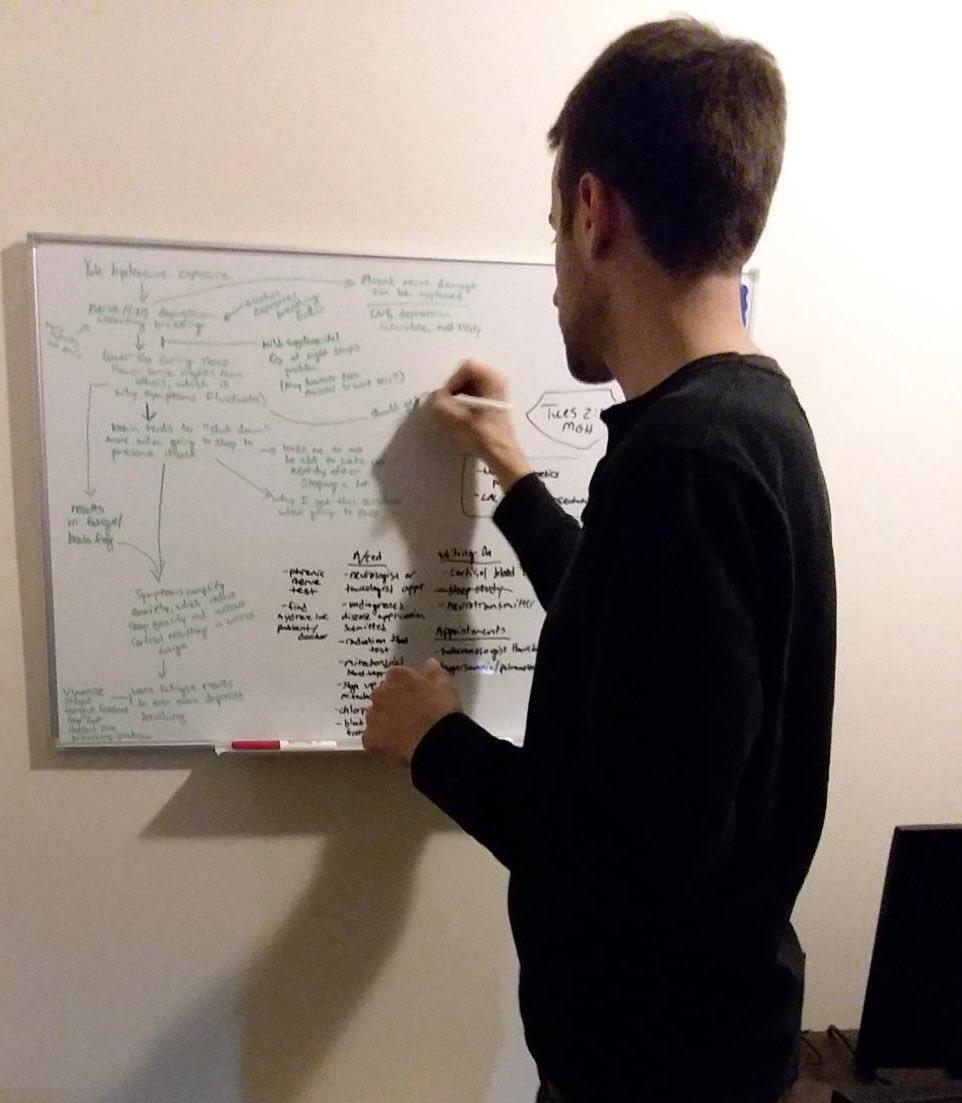
S4 — Mapping theories and biopathways on my whiteboard for years, obsessing over finding answers as to why I was chronically ill. Within five months of the exposure I had been hospitalized six times, every major test had come back normal, and doctors kept telling me it was depression or anxiety. I spent this period mapping biological pathways and testing every theory available: B12 deficiency, craniocervical instability, clotting disorders, genetic variants, mast cell activation (S4). Each was either not present in my case or did not respond to treatment. I saw more than a hundred doctors. At the worst of it my father had to carry me into appointments because I was unresponsive.
My mistake in this period was focusing on the direct toxicity of the substance that started it. I was looking for a poison. The problem was not a poison.
-
2021
The apartment that made it visible
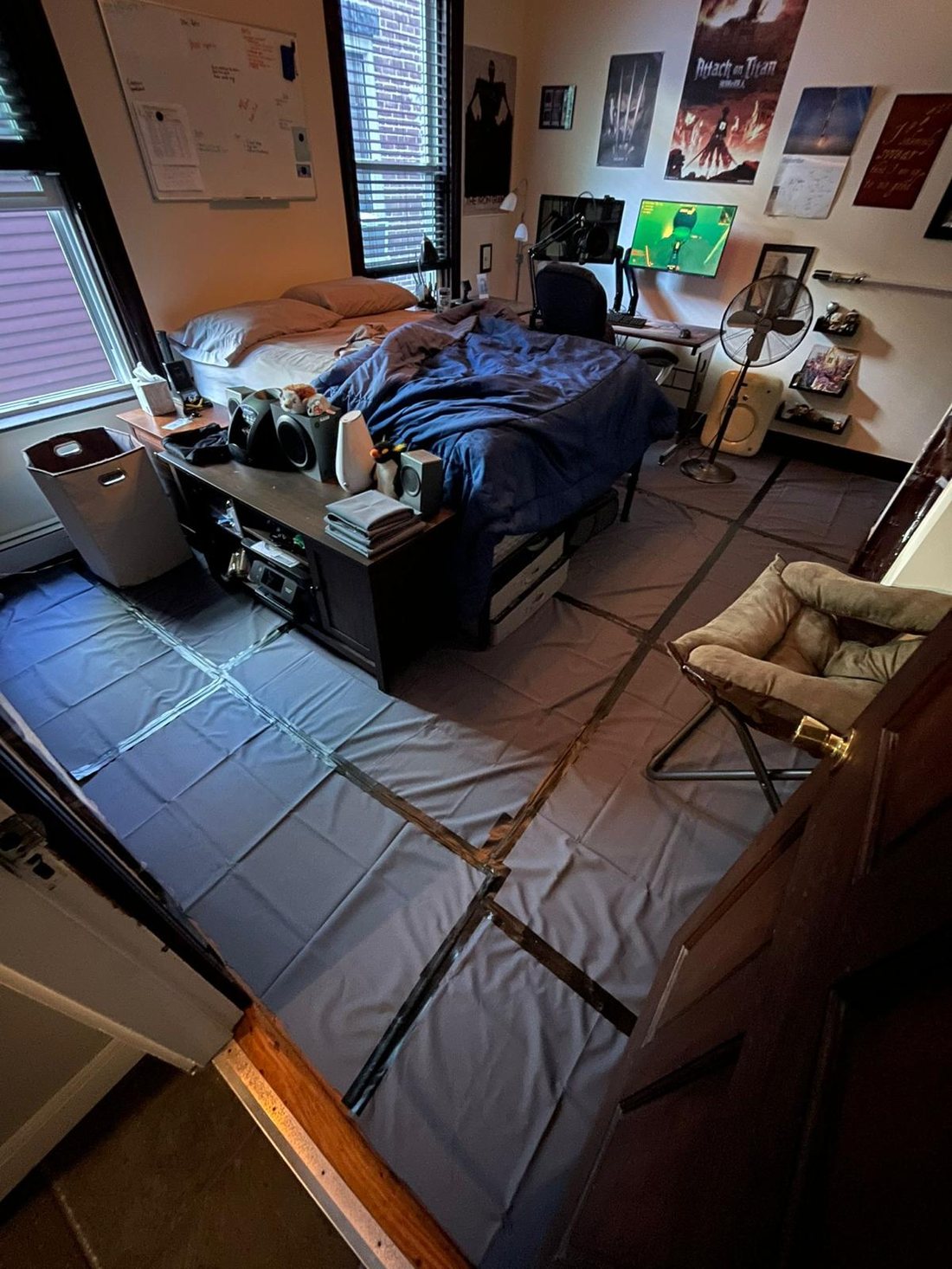
S5 — A bedroom floor fully sealed under taped sheeting, in the apartment, 2021–2022. I moved into a new apartment and deteriorated steadily. Eventually the difference between being inside and outside became sharp enough to notice. A mold test found heavy growth outside the building, likely blowing in through the windows, and the symptoms stopped when I wore a mask indoors.
But in the bedroom I had a completely different set of symptoms, and the mask made no difference to them. I concluded the bedroom had a VOC problem from the wood varnish — molecules small enough to pass straight through the filter (S5). Two exposures, two symptom profiles, in the same apartment.
That was the moment the illness stopped looking like one disease.
While I was still in that apartment I tried DNRS, the Dynamic Neural Retraining System, on the premise that the reaction was a learned or sensitized nervous-system response I could train my way out of by gradually recalming around the trigger. It did not help me adapt. It kept me in that exposure significantly longer than I would otherwise have stayed, because I believed that if I could just calm my mind and cope, the exposure itself would stop being a problem. It does not work that way when what is happening is physical damage rather than sensitization. Avoidance is what mattered, and DNRS trains the opposite of avoidance. I attribute a real, permanent part of my physical decline to staying in that apartment on DNRS's advice, and I would not recommend it to anyone in a similar position.
-
2021
Four days in a freshly painted room
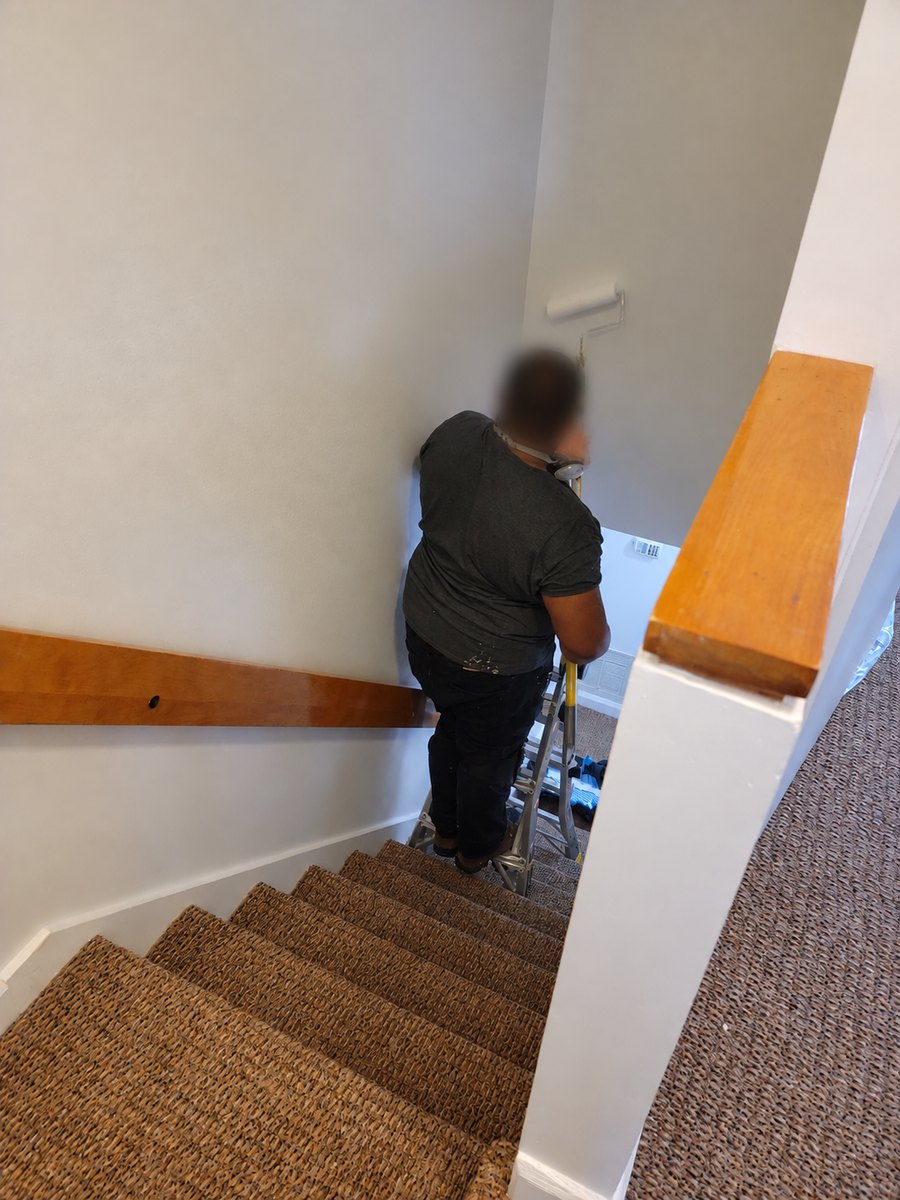
S6 — A painter rolling paint onto the stairwell wall. This is the single event that changed the trajectory most. I spent four continuous days in a room finished in matte white paint (S6). Matte white is high in titanium dioxide and has a low ratio of binder to pigment, which means the surface sheds easily. My partner was in the same room the whole time and was fine. I was not. Nothing else about the environment differed between us — which is the closest thing to a controlled comparison I have, and why I read this as an acquired susceptibility rather than a universal toxin.
Airing the room out for weeks did nothing. Neither did repainting, air filtration, changing the HVAC filters, cleaning with baking soda or washing the carpet. This was the only exposure I have had where the symptoms kept getting worse after I left it.
What changed afterward: my joints began traveling past their normal end range. My skin became pale, striated, slow to heal and easy to damage. The shape of the muscles in my forearms visibly changed. The disease would advance in response to mechanical force — using a massage gun made it worse. And I acquired a new vulnerability, where fiber and polymer exposures would leave my head feeling clogged.
(A photo of the skin striations (E11) described here, and photos and a video of the fingernail changes (E23) and joint laxity (E12) described in this section, are on the evidence page.)
I could physically tell my lymphatic system was blocked, and had to manually drain my head and limbs to get any relief. Symptoms migrated around my body for the first year or two, never staying in one place. After a lymphatic massage in 2022 I had a distinct gritty taste, like a mouthful of sand.
-
2022
Becoming Severe
As my health continued to worsen sharply, I was forced to leave both of my jobs, and I lost all the progress I had worked so hard to make in improving my health. When the distance, the health problems and our living situation became too much to bear, my long-term girlfriend left. My feelings about that are still conflicted. On one hand, there was a lot of hurt in feeling abandoned at my lowest point. On the other, I can barely tolerate living with this illness myself, so could I really expect someone else not to take a way out if they had one?
I have been denied workers' compensation for the chemical exposure that caused the illness, denied unemployment, denied disability twice, and turned down by the Undiagnosed Diseases Network twice. I have received no assistance of any kind, and have spent tens of thousands of dollars of my own money on it.
The one partially subsidized apartment complex in my state for people with disabilities has a waiting list eight years long. When I called Massachusetts to see whether moving out of state would help, I was told their voucher program was running fourteen years.
-
2022–26
Living outdoors
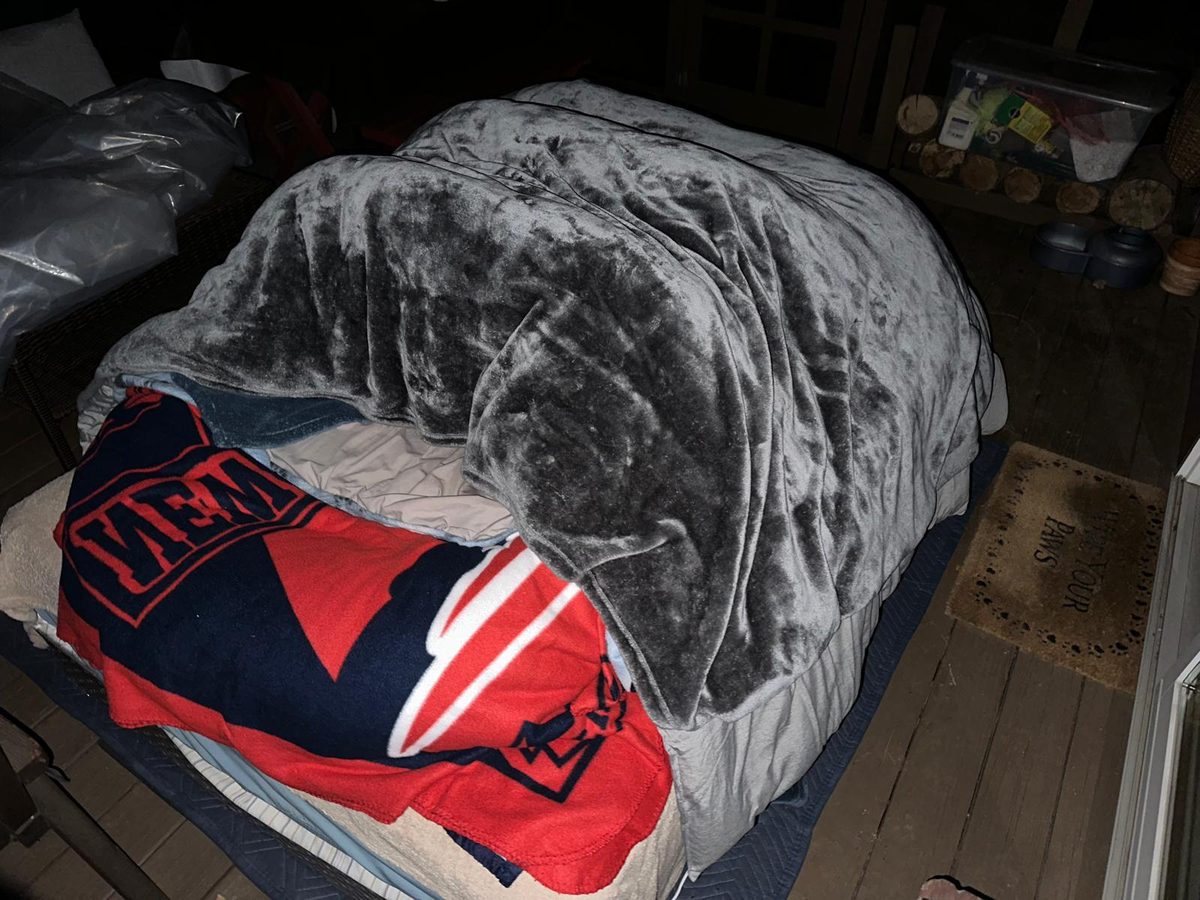
S7 — The bed I set up on my parents' screened-in porch in late 2022, when I started sleeping outdoors full time to slow my decline. That same year, cold weather triggered another sharp drop in function.
For the past year I have lived outdoors full time, completely uncovered — no tent and no enclosed space. Before that, for roughly three more years, I cycled through every indoor arrangement I could think of trying to make a room survivable: motel rooms, sealing a bathroom floor behind a closed door, covering rooms in tarps, foil and shower curtains, cotton mosquito netting, a cot under a glass panel, redoing flooring, sleeping on a porch, sleeping with my head out of a window (S7, S8).
None of it held. So it has been Connecticut through the fall, everything I own packed into the car, driving alone to Florida for the winter, and constant movement between campsites and state parks (S9). Dew and frost. Bears. Mosquitoes and poison ivy. Smoke from campfires, wildfires and controlled burns (S11).
This is not a lifestyle choice and it is not a treatment I would recommend to anyone. It is the only way I have found to reduce exposure enough to stay alive.
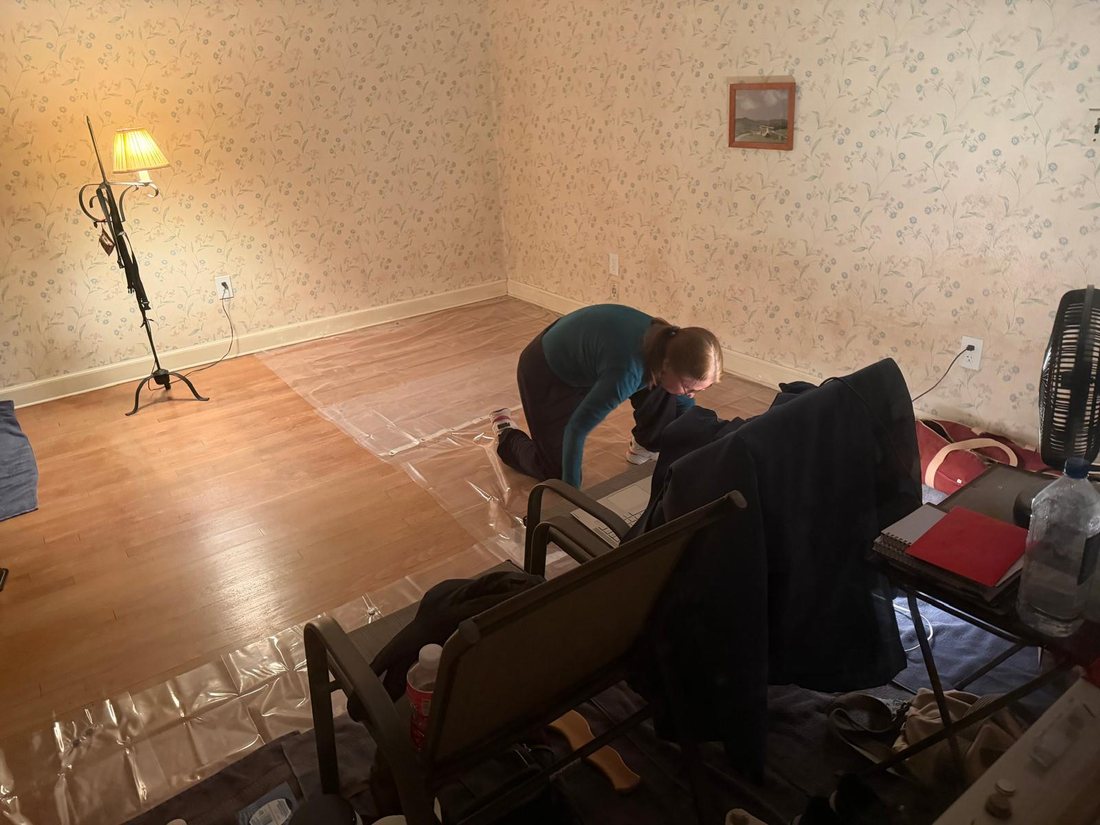
S8 — Taping clear sheeting over the hardwood floor of a bedroom I was trying to make livable for the winter, 2025. Some of what that has actually meant, in the past year alone: sleeping outside in a rainstorm, uncovered, more times than I can count. Climbing a ladder through a window to sleep on a sealed bathroom floor. Sleeping on a board propped on a table with my head out the window in winter, and waking up with my pillow frozen solid and my nose gone purple — the kind of cold where a hot shower doesn't register. Sleeping with a knife in my pocket because of bobcats near the campsite. Driving 1,100 miles in one sitting, alone, just to reach air I could breathe. Sleeping in the woods behind an avocado tree on someone's farm because there was nowhere else to go. All of it while my nervous system and muscles kept deteriorating underneath it. Scott Daniska, from an account posted while this was happening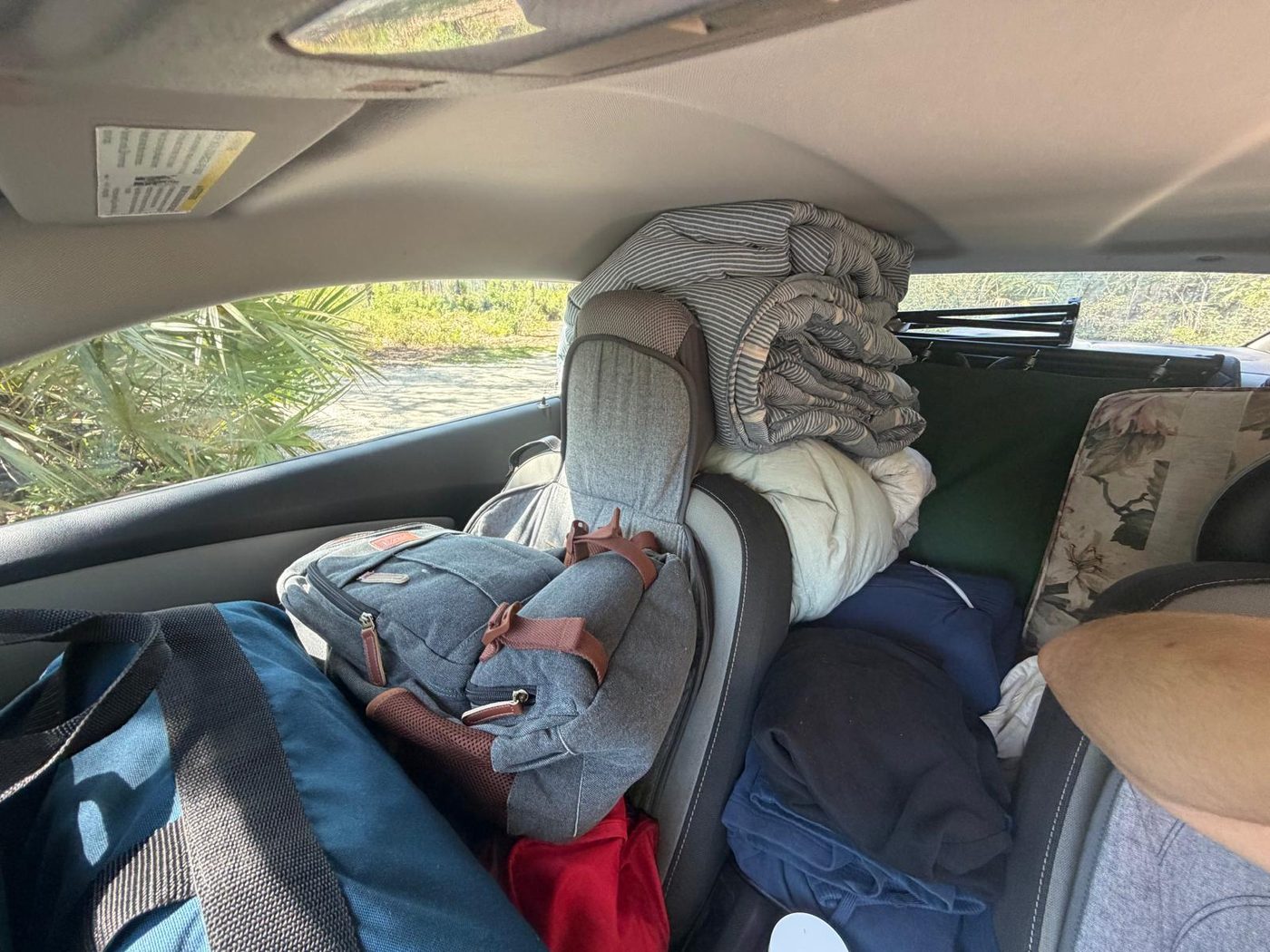
S9 — Everything I own, packed for the drive south. 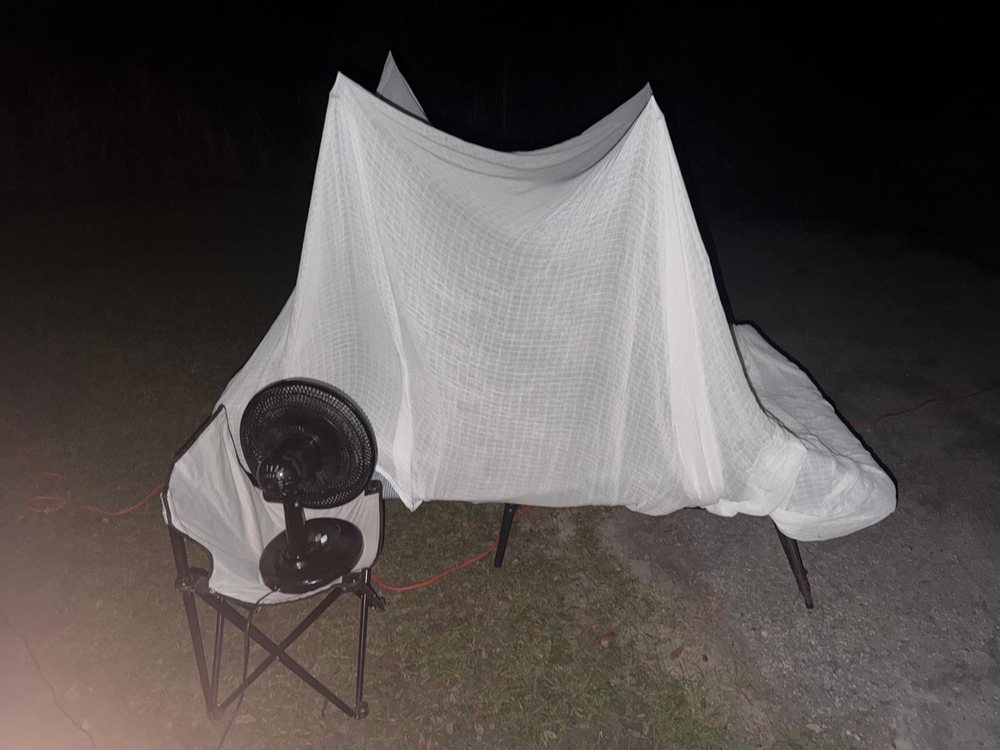
S10 The netting (S10) is insect netting, not a tent — none of these attempts amounted to an enclosed space, which is why the account above says none of it held.
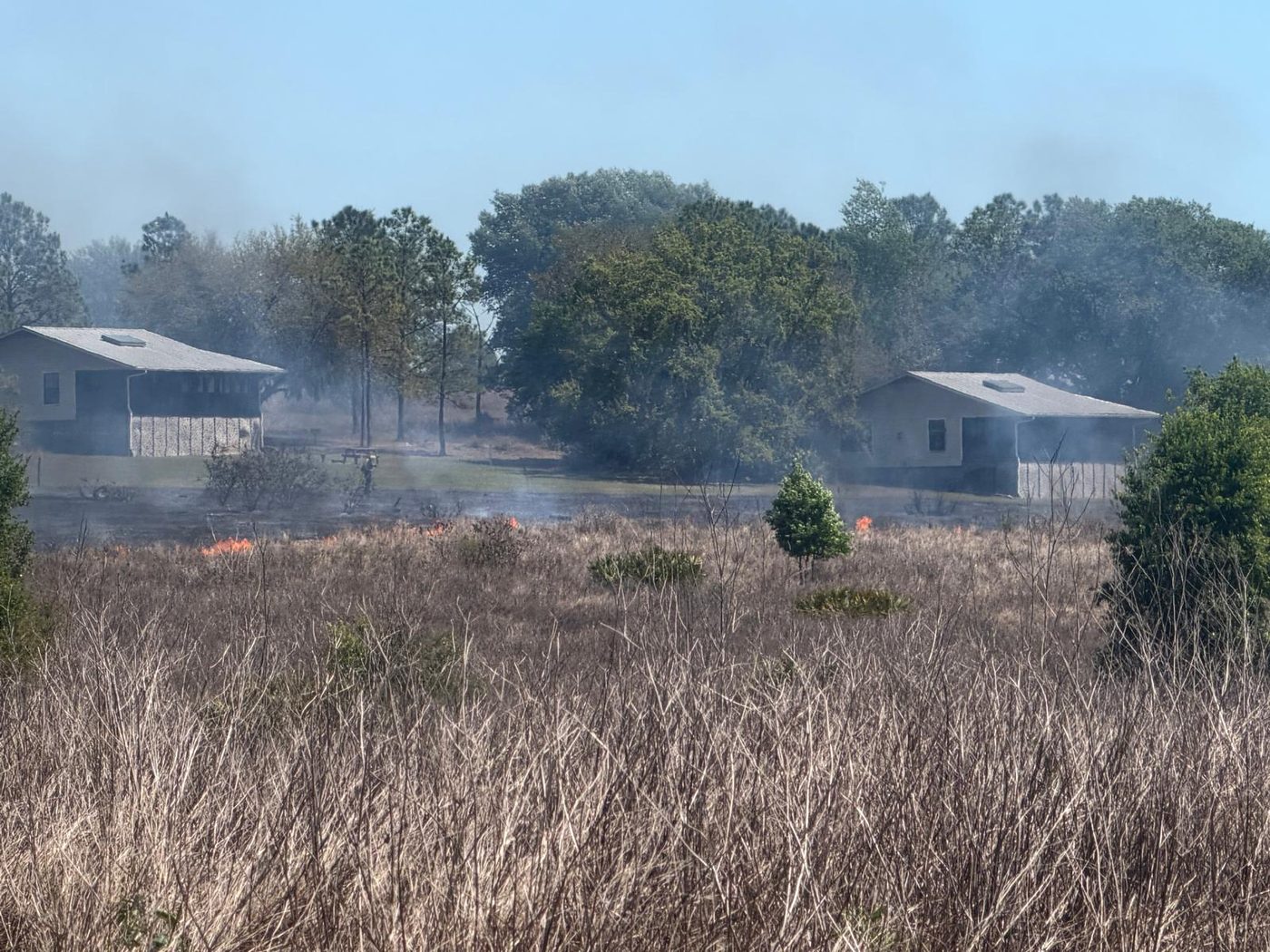
S11 — Smoke from a controlled burn, one of the recurring exposures living outdoors brings. The current stretch — about a year of this so far, and ongoing.
Step-down events
My decline has not been gradual. It happens in abrupt drops — my baseline capacity resets to a lower level and stays there. It does not come back on its own.
What triggers one: lying on or bending my spine, mental overexertion, sugar and carbohydrates, chemical exposures such as VOCs and smoke, and cold weather. What it feels like: my chest goes dead, I become short of breath, and I feel deflated. Blood flow to my brain seems to drop, which makes the suffocating feeling worse. Sometimes I feel like I am about to pass out and have to start running to stop it. Afterward there is a permanent increase in weakness in my limbs.
Since the start of 2026 these events have come with tinnitus, followed by hearing loss at specific frequencies.
A few of the other specific sensations from the past month alone: zapping in my right fingertips, sudden permanent limpness in my left arm, extreme soreness in my right hip only when walking, a feeling like my spine is tearing apart when I lean forward, a stabbing sensation in my left wrist, pins and needles in my head, a feeling like brain damage after eating a couple of cookies, a suffocating feeling in my head, nausea from being in a car, and an icy-cold feeling in my chest. Fatigue is almost an afterthought next to any of it.
I used to be able to feel my heartbeat in my extremities after overexertion. Since getting this illness, I can't — blood flow is bad enough that nurses regularly comment on how long my blood draws take.
One thing I did not expect: my fingernails record them. A new change appeared with each major step-down and each change adds to the last — Terry's nails and mild clubbing at the start of the illness in 2017, ridging and opacity after the paint exposure in 2021, and cuticle loss when the cold hit in 2023. (Photos (E23) are on the evidence page.)
On reading this as a patient. The exposures that drove my illness were specific to my history and my biology, in a particular order. I would not assume the same sequence applies to anyone else, and I would be careful about drastic changes to your living situation on the strength of one person's account. The mechanism is the part I think generalizes.